

Allied Health Practice Growth Program: How to Find the Right Fit

A full diary can still leave you carrying every clinic decision. If a roster question, fee schedule change or patient handover still waits for your approval, the right allied health practice growth program needs to address your clinic’s real constraint.
You already know growth can bring more complexity without giving you more freedom. The useful question is which kind of support fits your clinic’s stage, priorities and capacity to implement change.
This guide will help you identify your main operational bottleneck, compare support formats and clarify what to expect from each. You’ll leave with a practical next step towards more sustainable clinic operations.
Key Takeaways
- Pinpoint the clinic constraint that keeps decisions, such as roster changes or patient handovers, dependent on your approval.
- Choose an allied health practice growth program that matches your priority, decision-makers and capacity to put changes into practice.
- Compare support formats by the work involved, implementation expectations and measures of progress, rather than the label alone.
- Use Winnie’s experience building Movement Laboratory and Papaya Clinic to assess whether the approach connects strategy with practical clinic systems.
What should an allied health practice growth program help your clinic change?
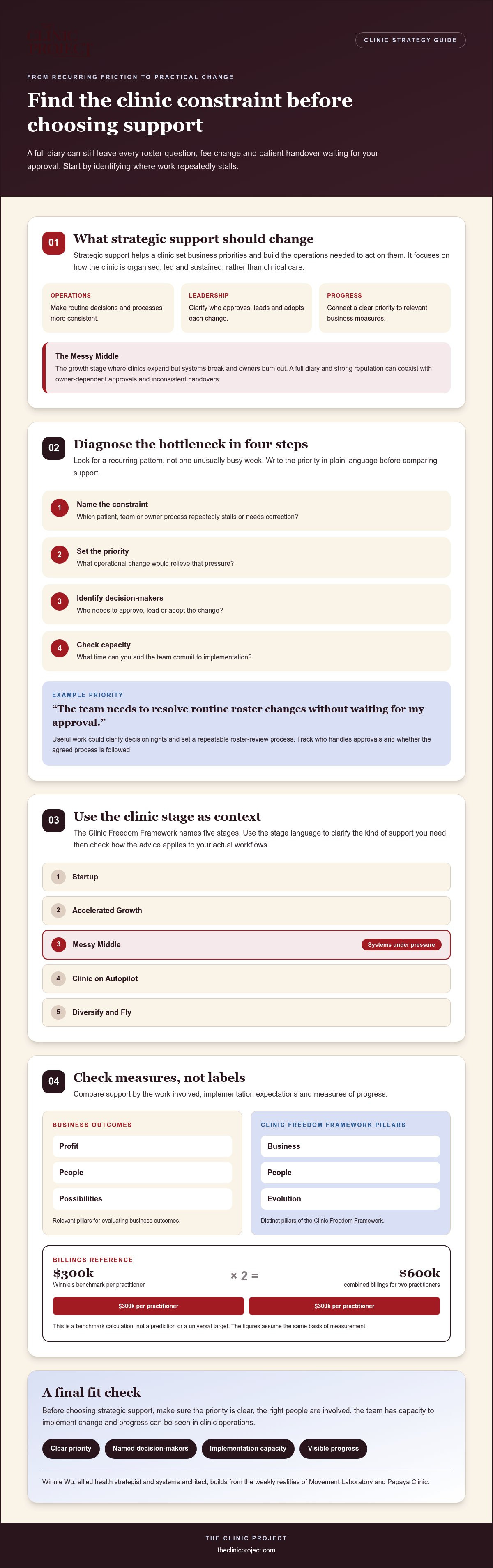
An allied health practice growth program is structured strategic support that helps a clinic set business priorities and build the operations needed to act on them. It focuses on how the clinic is organised, led and sustained, rather than clinical care for patients. Allied health professionals work across disciplines, so the right business priorities will depend on your services, team and clinic stage.
The Messy Middle: the growth stage where clinics expand but systems break and owners burn out. A full diary and strong reputation can coexist with an owner approving every roster change, a handover process that varies by practitioner, and little time to review profitability. Clinical expertise builds patient trust; reliable business operations need their own structure.
Business support should also be distinct from practice-management software, which provides tools for clinic administration, and staff placement, which fills roles. Strategic support helps you decide what needs to change and how to organise the work.
When does structured business support fit an allied health clinic?
Look for a recurring pattern, rather than one unusually busy week. If the same leave request, fee schedule question or patient follow-up decision keeps landing with you, while processes differ between practitioners, the constraint is operational. That pattern limits time for strategic work even when patient demand and clinical reputation are strong.
What should a clinic owner expect from a growth program?
Expect a clear priority, relevant business measures and practical operational improvements, matched to the clinic’s stage and main constraint. For example, if a physiotherapy clinic’s team waits for the owner to approve each roster adjustment, useful work could clarify decision rights and set a repeatable roster-review process. Progress should be visible in how decisions are made and how consistently the process is followed.
As an allied health strategist and systems architect, I build from what I use across Movement Laboratory and Papaya Clinic: strategy must connect to the weekly realities of clinic operations.
How can you assess an allied health practice growth program against your clinic’s needs?
Before comparing support, identify where work repeatedly stalls. A full physiotherapy roster is a symptom; the underlying constraint could be unclear delegation, inconsistent follow-up or limited visibility over finances. Write one priority in plain language, such as “the team needs to resolve routine roster changes without waiting for my approval”.
- Name the constraint: Which patient, team or owner process repeatedly stalls or needs correction?
- Set the priority: What operational change would relieve that pressure?
- Identify decision-makers: Who needs to approve, lead or adopt the change?
- Check capacity: What time can you and the team commit to implementation?
Include recurring decisions in your diagnosis, such as fee adjustments, leave cover or patient handovers. For a numerical reference, the benchmark I have used since 2023 is $300k in annual billings per practitioner. Compare your own figure against it before deciding what to fix first.
Check the measures and frameworks behind the advice
The Clinic Freedom Framework names five stages: Startup, Accelerated Growth, Messy Middle, Clinic on Autopilot, and Diversify and Fly. Use the stage language to clarify the support you need, then check how advice will apply to your clinic’s actual workflows. For sector context, Allied Health Professions Australia is the peak body for the Australian allied health workforce.
Ask how progress will be assessed. Tie measures to your priority, such as who handles roster approvals and whether the agreed handover process is followed.
Use your written priority to compare an allied health practice growth program with your clinic’s needs, then explore strategic support for your clinic.
How do allied health practice growth program formats differ?
Choose the format by the work your clinic needs to complete. A recurring roster bottleneck calls for operational structure; a leadership or strategic question benefits from a different kind of support. Ask how the approach accounts for allied health realities, including practitioner utilisation, patient follow-up and the mix of private, Medicare, NDIS or WorkCover work.
| Clinic need | Support format | Questions to confirm |
|---|---|---|
| Inconsistent processes or routine decisions still landing with you | Foundational systems work, such as Set to Scale | How does the work help strengthen clinic systems and operations? What implementation support and participation are included? |
| Strategic perspective and peer discussion for an established clinic | Impact Mastermind | How are priorities shaped around my clinic’s stage, team and current constraint? |
| A defined business question that needs a focused plan | Focused planning | What will the plan cover, and how will it connect to action in the clinic? |
| Dedicated time for strategic planning and concentrated work | CEO Weekend or an intensive working session | What is the current format, what is included, and what preparation or follow-through is expected? |
Set to Scale is relevant when your priority is stronger systems and more sustainable operations. For example, if clinicians need your approval to resolve routine handover questions, ask how the program helps establish clearer responsibilities and a repeatable process. Confirm the current inclusions and time commitment directly before deciding.
For any format, ask how the provider identifies priorities, adapts advice to allied health clinics and supports implementation. A plan should connect to the everyday details of care delivery, such as who checks an incomplete patient handover and when the team reviews the process. I bring that operator’s perspective from building Movement Laboratory and Papaya Clinic.
If strategic support feels like the right next step, Book an Impact Call with Winnie.
How do you choose an allied health practice growth program and take the next step?
Choose support that matches your clinic’s priority, stage and capacity to implement change. Before committing, check four things:
- Priority: Can you name the main constraint, such as every roster adjustment waiting for your approval?
- Provider fit: Does the provider understand allied health operations, including practitioner capacity, patient experience and the realities of your service mix?
- Implementation: Is it clear who will put recommendations into practice, and what participation the program requires?
- Measures: Will you track progress with relevant indicators, such as how routine decisions are handled or whether agreed processes are followed?
As the founder of Movement Laboratory and Papaya Clinic, I look for business structures that hold up in a working clinic, from who owns a patient handover to how the roster is reviewed. I’ve grown two clinic brands while taking three to four months off each year since 2022. That experience shapes my view: profit gives you choice, systems give you time, and leadership gives you freedom. A full diary alone doesn’t show whether the clinic is becoming more sustainable.
Set to Scale members average a 32% profit margin, compared with an industry average of around 15%.
Bring your clinic stage, main constraint and desired direction to a conversation with Winnie Wu, The Clinic Project founder and allied health strategist, who works directly with clients. A clear discussion can help you assess fit without assuming a particular outcome.
Book an Impact Call with Winnie
Choose support that fits your clinic’s next stage
The right allied health practice growth program should match your clinic’s main constraint, stage and capacity to put changes into practice. Before deciding, name the business priority, who will lead the work and what measure will show progress. A full diary alone can’t tell you whether the clinic’s operations are sustainable.
As founder of Movement Laboratory and Papaya Clinic, I use practical clinic systems to connect strategic decisions with daily work, from clarifying who owns a patient handover to setting a consistent roster process. The next step is to choose support that fits the work your clinic needs now, with clear expectations for implementation.
If you’d like to talk through your clinic’s stage, constraints and priorities, Book an Impact Call with Winnie.
A focused conversation can help you decide what to address first.
Frequently Asked Questions
What is an allied health practice growth program?
An allied health practice growth program provides structured strategic support for a clinic’s business priorities, such as improving operations, strengthening systems and building sustainable revenue. The work connects strategy with practical implementation, guided by your clinic’s stage and constraints. It supports business decisions rather than clinical care, software provision or staff placement.
How do I know if my allied health clinic is ready for a growth program?
Readiness starts with one clear priority and capacity to make time for strategic work. Identify a recurring issue, such as roster changes that repeatedly need your approval, who needs to help address it and how you’ll review progress. Your systems don’t need to be perfected first.
What should I compare when choosing a clinic growth program?
Compare the provider’s allied health experience, support format, implementation expectations and approach to measuring progress. Ask how the work will reflect your clinic’s stage and constraint, then confirm current inclusions and time commitments directly. For example, if patient handovers vary between practitioners, clarify how the support will help establish a consistent process and how your team will review whether it is being used.
Can a growth program help me spend less time in day-to-day clinic operations?
A growth program can help you examine the systems, delegation and decision-making that keep you involved in daily clinic operations. Reduced hours depend on your circumstances and how agreed changes are implemented, so they shouldn’t be promised. Start by listing recurring approvals, such as leave cover or routine handover questions, then identify which could become clear team processes and how you’ll review the change.

Article by
Winnie Wu
Physiotherapist Winnie Wu builds allied health clinics that are highly profitable and run without their owner. She has founded four health brands. Her two Sydney clinics, Movement Laboratory and the award-winning Papaya Clinic, let her take three to four months off every year. Through The Clinic Project she works directly with women clinic owners on profit, systems and leadership, and her Set to Scale clients average a 32% profit margin, more than double the industry average. Every framework she teaches runs in her own clinics first.